Proper drainage is one of the most important — and also often overlooked — elements of a healthy landscape. Poor drainage can lead to standing water, lawn damage, foundation concerns, and long-term erosion issues around the property. Addressing drainage early helps protect your home while keeping your outdoor space usable, stable, and visually appealing throughout the seasons.

In many cases, drainage issues begin with improper grading around the property and landscape. Adjusting the slope of the landscape allows water to naturally flow away from structures, patios, and lawn areas where pooling may occur. Proper grading is often the first and most effective step in solving many common drainage problems.

Channel drains are installed in hard surfaces such as patios, driveways, walkways, or garage approaches to collect surface water. These linear drainage systems prevent pooling that can occur after heavy rain or snowmelt. Water is captured and directed safely away from structures, outdoor living areas, and paved surfaces.

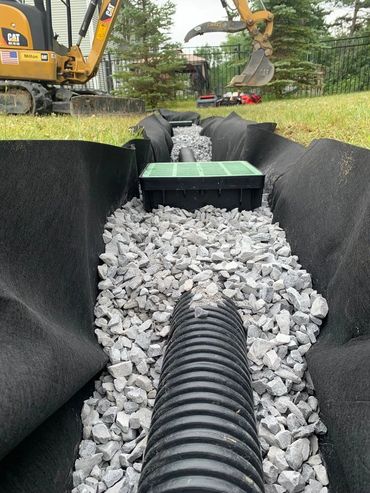
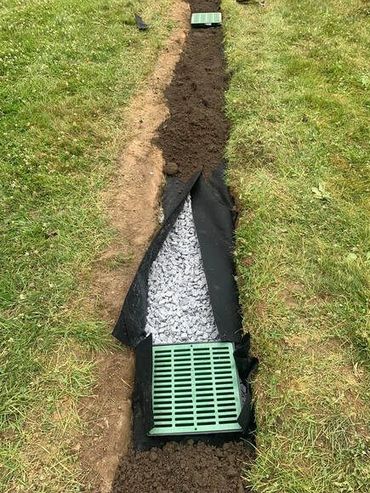
French drains, among other subsurface drainage systems, redirect excess groundwater away from areas where water collects or saturates the soil. A perforated pipe surrounded by clean drainage stone allows groundwater to enter the system, while solid pipes can be implemented to carry water away toward a safer discharge location.

In areas where water naturally collects, strategic planting and landscape design can help manage excess moisture. Certain plants and landscape features are better suited to wetter soil conditions and occasional saturation. These approaches help absorb water, stabilize soil, and improve the appearance of naturally damp areas.

Drainage issues often show up in ways that seem minor at first, but they usually point to a larger water management problem. You may notice water pooling near your foundation, soft or muddy areas that stay wet for days, runoff collecting on patios or driveways, erosion along garden beds, or low spots where grass struggles to grow. In many cases, these problems are caused by improper grading, hard surfaces that trap water, or runoff that has nowhere effective to go.
Every property handles water differently, which is why the right solution starts with understanding how water is moving through the space. We look at slope, surface runoff, downspout discharge, low areas, and how the surrounding landscape affects drainage. From there, we recommend the most effective solution for the problem at hand—whether that means correcting grade, installing a channel drain, adding a subsurface drainage system, or combining several approaches into one complete fix.
Different drainage problems call for different solutions. Water collecting against the house may require regrading and better discharge routing. Pooling at the edge of a driveway or garage may be best addressed with a channel drain. Persistent soggy areas in a lawn may benefit from subsurface drainage or reshaping the area to move water more naturally. In some cases, the best result comes from solving the issue in a simple, minimally invasive way. In others, it means building drainage into a larger landscape project so the property functions better as a whole.


Drainage problems are rarely solved properly by guessing or by forcing the same solution onto every property. We take the time to understand where the water is coming from, where it needs to go, and what approach makes the most sense for the space. That means looking at slope, runoff patterns, low areas, downspout discharge, and how hard surfaces and surrounding landscape features affect the movement of water. In many cases, that starts with grading—not just jumping straight to buried pipe or surface drains without considering the bigger picture.
Working with homeowners throughout Cambridge, Kitchener, Waterloo, and surrounding communities, our goal is to provide drainage solutions that work with the property, not against it. Whether the issue is runoff near the foundation, standing water in the yard, or drainage that needs to be built into a patio, driveway, or larger landscape project, we focus on practical solutions that are built for long-term performance. Homeowners trust us because we communicate clearly, recommend work honestly, and install with durability and function in mind.
Please reach us at visionarylandscaping2020@gmail.com if you cannot find an answer to your question.
Common signs include water pooling near the house, soggy lawn areas that stay wet for days, runoff crossing patios or driveways, erosion, or low spots where water collects after rain or snowmelt.
In some cases, yes. Correcting the slope of the ground is often the first and most important step. Other properties may require channel drains, subsurface drainage, or a combination of solutions.
Not always. French drains are one type of subsurface drainage system, but they are not the right answer for every situation. The best solution depends on how and where the water is collecting.
Yes. In many cases, drainage improvements such as channel drains or runoff control can be added to existing hardscape areas, depending on the layout and the source of the problem.
That depends on the property. The goal is to move water away from problem areas and direct it to a more suitable discharge point or area where it can be managed properly.
Henry J. Kaiser
Visionary Landscaping
356 Langlaw Drive, Cambridge, Ontario N1P 1B9, Canada